Women in Noncommutative Algebra and Representation Theory workshop 2.
University of Leeds. May 20 – 24, 2019.
Noncommutative algebra and representation theory are two closely intertwined areas of research that have strong ties to many other fields in mathematics and quantum physics such as conformal field theory, operator algebras, string theory, topological field theory, and the various guises of non- commutative geometry. Noncommutative algebra creates an algebraic framework for generalizing the study of polynomials to other rings that fail to be commutative. Representation theory is a powerful tool for investigating the action of an algebraic object on a space as linear operators and matrices. As in many areas of mathematics, women and non-binary researchers have been underrepresented in noncommutative algebra and representation theory. The goal of this workshop is to bring together some of the best experts and junior participants working on these topics to collaborate on research projects. All research group participants in the workshop will be women and non-binary researchers. This workshop will be the second of its kind for these fields. Like our first WINART workshop (held at BIRS in March 2016), WINART2 will have a great impact on the research careers of those in attendance, and as a result, it will positively impact the research area as a whole.
Organizers: Karin Baur, Georgia Benkart, Eleonore Faber (lead-local), Ellen Kirkman, Chelsea Walton (lead-nonlocal)
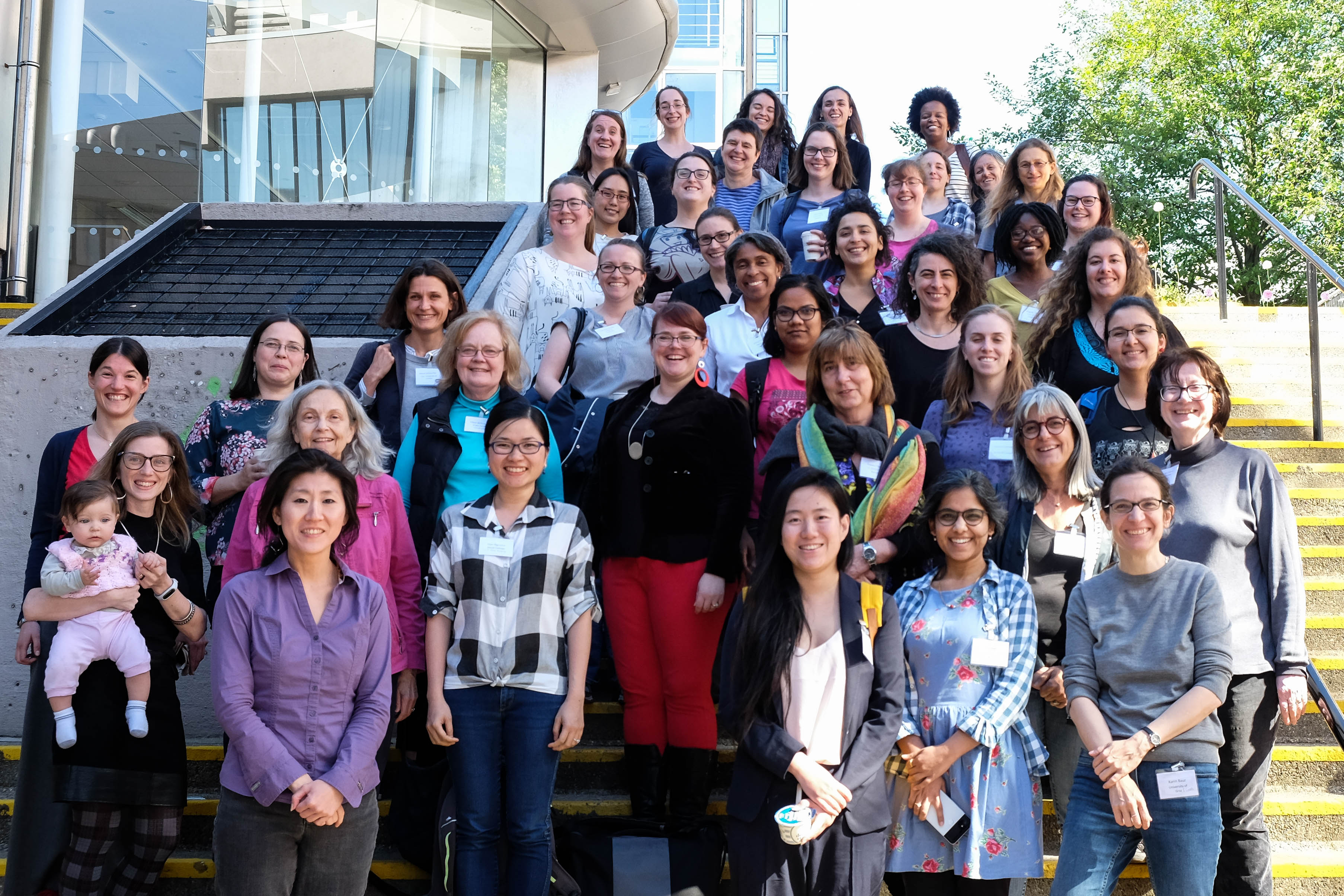
Our WINART2 poster by Tori Corkery, Math Dept at UIUC
Group Leaders and Participants
Workshop logistics
Workshop schedule and room locations (updated May 16, 2019)
Map of locations (Train station, hotel, campus locations, conference meal locations, and suggested dinner locations)
See Welcome Email sent on May 3, 2019 for additional information, with updated packet sent on May 16, 2019
Testimonials
“Working the whole group together at the same time was a great experience. Having most of the time devoted to do research was the favorite for me. It helps to connect with the other members, to have time to think and overcome difficulties in the projects. I also enjoyed the talks during the afternoon, they were really good speakers and interesting results.”
– Julia Plavnik
“I enjoyed our team work during the workshop. Each group member had strengths and our strengths complimented each other.”
– Angela Tabiri
“This was a very productive week for our group, and that was because of as small number (very enjoyable) talks as possible, and as large number of hours for research as possible. I enjoyed working there a lot and hope to be a part of it again!”
– Maitreyee Kulkarni
“Our group was mathematically diverse, but cohesive in terms of the project. Everyone was able to make essential contributions and because of the different backgrounds, we all feel like we learned a lot. While we achieved a lot mathematically, the atmosphere in our group was very inclusive and we all were able to ask any question we had without feeling exposed.”
– Sibylle Schroll
“[I enjoyed] young and more senior mathematicians working together as equal – it was so much fun.”
– Gordana Todorov
“This workshop gave an opportunity to collaborate with people I knew from conferences and visits, but never had a chance to work with.
It was also wonderful and inspiring to talk to so many women in math.”
– Maitreyee Kulkarni
“I was always wanted to expand my research interests outside the subject of my PhD thesis. The teaching, the application process etc take so much time, that I usually focus on research areas I am already familiar with. This week not only I learnt and I worked on a new area, but I was doing this in an everyday basis, which helped a lot to start seeing progress in a short period of time. Moreover, I had the opportunity to collaborate with new people, learn about new techniques and expand my research interests. Being in a conference like that, seeing everyone around me working hard was really an inspiration for me.”
– Eirini Chavli
“The organizers did a wonderful job! The workshop went very smoothly and we had an awesome time! These research workshops like WINART are really beneficial to (especially young) women mathematicians to make connections and form collaborations. (THANK YOU!)^{\infinity} to the organizers and various funders to make such workshops as WINART happen!”
– Van Nguyen
Some anonymous testimonials:
“Everyone was very nice and open. Senior mathematicians really want to help new researchers.”
“I am collaborating with new people and, in principle, far from my mathematical expertise. The exchange of ideas has been very fruitful because of such differences, and I hope it will continue. Creating [these] ‘unnatural’ collaborations is very enriching.”
“[It was] nice to have so many women together working in similar areas and the genuine collaborative atmosphere rather than the sometimes competitive antagonistic ones at other conferences.”
“The workshop should be commended for its inclusion of a diverse group of female mathematicians, providing a great platform to meet and network with other women in similar research areas. Moreover, the workshop provided a supportive working environment within its groups.”
“It was great breaking into a new area of research (particularly representation theory from a different perspective). I also enjoyed hearing about what the other groups were accomplishing.”
Funding
Funding has been provided by the London Mathematical Society [Workshop Grant Ref. WS-1718-03], the University of Leeds [conference grant], the US National Science Foundation [Conference Grant No. DMS 1900575], the Association for Women in Mathematics [NSF Grant No. DMS-1500481], and also by a research fellowship from the Alfred P. Sloan foundation.